Construction : différence de deux vecteurs
Créez un compte gratuit pour suivre votre avancement et reprendre où vous avez laissé.
Créer un compteObjectif travaillé
Soient $ A, B $ et $ C $ trois points non alignés du plan.
Construire les points $ D $ et $ E $ tels que : $ \overrightarrow{AD}=\overrightarrow{AB} - \overrightarrow{BC} $ et $ \overrightarrow{AE}=\overrightarrow{AB} - \overrightarrow{AC} $
Corrigé
$ - \overrightarrow{BC}=\overrightarrow{CB} $
donc
$ \overrightarrow{AD}=\overrightarrow{AB} - \overrightarrow{BC}=\overrightarrow{AB}+\overrightarrow{CB} $
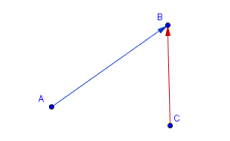
1ère étape :
On trace les vecteurs $ \overrightarrow{AB} $ et $ \overrightarrow{CB} $
2ème étape :
On reporte le vecteur $ \overrightarrow{CB} $ « à la suite » du vecteur $ \overrightarrow{AB} $.
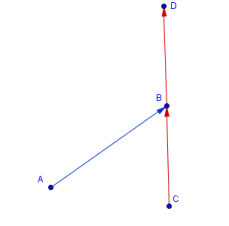
On obtient le point $ D $ à l'extrémité de ce vecteur.
On a bien :
$ \overrightarrow{AD}=\overrightarrow{AB}+\overrightarrow{BD} $ (relation de Chasles)
$ \overrightarrow{AD}=\overrightarrow{AB}+\overrightarrow{CB} $ (car $ \overrightarrow{BD}=\overrightarrow{CB} $)
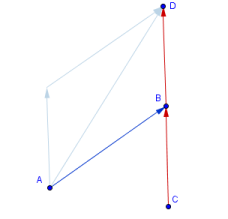
N.B. On peut aussi reporter le vecteur $ \overrightarrow{CB} $ à partir du point $ A $ et tracer le parallélogramme ci-dessous :
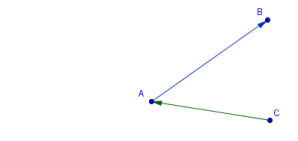
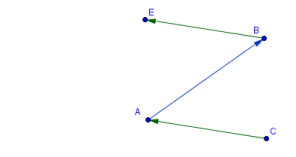
La construction est similaire pour le point $ E $
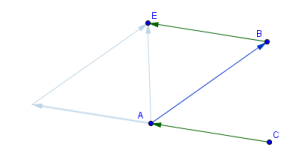
$ \overrightarrow{AE}=\overrightarrow{AB}+\overrightarrow{CA} $
1ère étape :
2ème étape :
Avec le parallélogramme :