Compléter un parallélogramme par les coordonnées
[enonce]
Dans un repère orthonormé $(O ; \vec{i}, \vec{j})$, on considère les points $A(0 ; 2)$, $B(6 ; 0)$ et $C(8 ; 4)$.
On cherche à déterminer les coordonnées du point $D$ tel que $ABCD$ soit un parallélogramme.
[/enonce]
[etape]
Pour que $ABCD$ soit un parallélogramme, quelle condition vectorielle doit être vérifiée ?
[qcm]
[option]$\overrightarrow{AB} = \overrightarrow{CD}$[/option]
[option correct="true"]$\overrightarrow{AB} = \overrightarrow{DC}$[/option]
[option]$\overrightarrow{AC} = \overrightarrow{BD}$[/option]
[reponse statut="correct"]Correct !
Un quadrilatère $ABCD$ est un parallélogramme si et seulement si $\overrightarrow{AB} = \overrightarrow{DC}$ : les côtés opposés sont représentés par le même vecteur.[/reponse]
[reponse motif="$\overrightarrow{AB} = \overrightarrow{CD}$"]Attention au sens : $\overrightarrow{CD}$ va de $C$ vers $D$, mais le côté opposé à $[AB]$ va de $D$ vers $C$. La condition porte sur $\overrightarrow{DC}$, pas $\overrightarrow{CD}$.[/reponse]
[reponse motif="$\overrightarrow{AC} = \overrightarrow{BD}$"]Les segments $[AC]$ et $[BD]$ sont les diagonales, pas les côtés opposés du quadrilatère.[/reponse]
[/qcm]
[/etape]
[etape]
Calculer les coordonnées du vecteur $\overrightarrow{AB}$.
L'abscisse est $x_{\overrightarrow{AB}} =$ [[xab]] et l'ordonnée est $y_{\overrightarrow{AB}} =$ [[yab]].
[math id="xab" attendu="6"]
[reponse statut="correct"]Oui ![/reponse]
[reponse motif="-6"]Le vecteur va de $A$ vers $B$ : on calcule $x_B - x_A$, pas l'inverse.[/reponse]
[reponse statut="incorrect"]Appliquer la formule $x_B - x_A$ avec les abscisses de $A$ et $B$.[/reponse]
[aide essai="2"]$x_{\overrightarrow{AB}} = x_B - x_A$.[/aide]
[aide essai="3"]$x_{\overrightarrow{AB}} = 6 - 0$.[/aide]
[/math]
[math id="yab" attendu="-2"]
[reponse statut="correct"]Bonne réponse !
On a $\overrightarrow{AB}\begin{pmatrix} 6 \\ -2 \end{pmatrix}$.[/reponse]
[reponse motif="2"]Le signe est incorrect : $y_{\overrightarrow{AB}} = y_B - y_A = 0 - 2$.[/reponse]
[reponse statut="incorrect"]Appliquer la formule $y_B - y_A$ avec les ordonnées de $A$ et $B$.[/reponse]
[aide essai="2"]$y_{\overrightarrow{AB}} = y_B - y_A$.[/aide]
[aide essai="3"]$y_{\overrightarrow{AB}} = 0 - 2$.[/aide]
[/math]
[solution]$\overrightarrow{AB}\begin{pmatrix} x_B - x_A \\ y_B - y_A \end{pmatrix} = \begin{pmatrix} 6 - 0 \\ 0 - 2 \end{pmatrix} = \begin{pmatrix} 6 \\ -2 \end{pmatrix}$.[/solution]
[/etape]
[etape]
En déduire les coordonnées du point $D$.
$x_D =$ [[xd]] et $y_D =$ [[yd]].
[math id="xd" attendu="2"]
[reponse statut="correct"]C'est ça ![/reponse]
[reponse motif="14"]On n'additionne pas $x_C$ et $x_{\overrightarrow{AB}}$. Le vecteur $\overrightarrow{DC}$ part de $D$ et arrive en $C$, donc $x_C - x_D = 6$.[/reponse]
[reponse motif="8"]Ce n'est pas $x_C$. La condition $\overrightarrow{DC} = \overrightarrow{AB}$ impose une relation entre les coordonnées de $D$ et celles de $C$.[/reponse]
[reponse statut="incorrect"]Écrire que $\overrightarrow{DC}$ a les mêmes coordonnées que $\overrightarrow{AB}$, puis isoler $x_D$.[/reponse]
[aide essai="2"]$\overrightarrow{DC} = \overrightarrow{AB}$ signifie $x_C - x_D = 6$.[/aide]
[aide essai="3"]$x_D = x_C - 6 = 8 - 6$.[/aide]
[/math]
[math id="yd" attendu="6"]
[reponse statut="correct"]Exactement !
Le point $D$ a pour coordonnées $(2 ; 6)$.[/reponse]
[reponse motif="2"]Attention au signe : $y_C - y_D = -2$, donc $y_D = y_C - (-2) = y_C + 2$.[/reponse]
[reponse statut="incorrect"]Écrire que $y_C - y_D = y_{\overrightarrow{AB}}$, puis isoler $y_D$.[/reponse]
[aide essai="2"]$\overrightarrow{DC} = \overrightarrow{AB}$ signifie $y_C - y_D = -2$.[/aide]
[aide essai="3"]$y_D = y_C - (-2) = 4 + 2$.[/aide]
[/math]
[solution]$\overrightarrow{DC} = \overrightarrow{AB}$ donne $\begin{cases} x_C - x_D = 6 \\ y_C - y_D = -2 \end{cases}$, soit $\begin{cases} x_D = 8 - 6 = 2 \\ y_D = 4 + 2 = 6 \end{cases}$.
Donc $D(2 ; 6)$.[/solution]
[/etape]
[etape]
Calculer les coordonnées du milieu de la diagonale $[AC]$.
$x_I =$ [[xi]] et $y_I =$ [[yi]].
[math id="xi" attendu="4"]
[reponse statut="correct"]Oui ![/reponse]
[reponse motif="8"]On calcule la moyenne des abscisses, pas leur somme.[/reponse]
[reponse statut="incorrect"]L'abscisse du milieu est la moyenne des abscisses des deux extrémités.[/reponse]
[aide essai="2"]$x_I = \dfrac{x_A + x_C}{2}$.[/aide]
[aide essai="3"]$x_I = \dfrac{0 + 8}{2}$.[/aide]
[/math]
[math id="yi" attendu="3"]
[reponse statut="correct"]Bravo !
Le milieu de $[AC]$ est $(4 ; 3)$. Le milieu de $[BD]$ est $\left(\dfrac{6 + 2}{2} ; \dfrac{0 + 6}{2}\right) = (4 ; 3)$.
Les diagonales se coupent en leur milieu : $ABCD$ est bien un parallélogramme.[/reponse]
[reponse motif="6"]On calcule la moyenne des ordonnées, pas leur somme.[/reponse]
[reponse statut="incorrect"]L'ordonnée du milieu est la moyenne des ordonnées des deux extrémités.[/reponse]
[aide essai="2"]$y_I = \dfrac{y_A + y_C}{2}$.[/aide]
[aide essai="3"]$y_I = \dfrac{2 + 4}{2}$.[/aide]
[/math]
[solution]Le milieu de $[AC]$ est $\left(\dfrac{0 + 8}{2} ; \dfrac{2 + 4}{2}\right) = (4 ; 3)$.
Le milieu de $[BD]$ est $\left(\dfrac{6 + 2}{2} ; \dfrac{0 + 6}{2}\right) = (4 ; 3)$.
Les deux diagonales ont le même milieu, ce qui confirme que $ABCD$ est un parallélogramme.[/solution]
[/etape]
QCM : Opérations sur les coordonnées
[enonce]
Ce QCM porte sur les opérations sur les coordonnées de vecteurs. Pour chaque question, choisissez la bonne réponse parmi les quatre propositions.
[/enonce]
[etape]
Soient $\vec{u}\begin{pmatrix} 2 \\ 3 \end{pmatrix}$ et $\vec{v}\begin{pmatrix} 4 \\ -1 \end{pmatrix}$. Quelles sont les coordonnées de $\vec{u}+\vec{v}$ ?
[qcm]
[option]$\begin{pmatrix} 6 \\ 4 \end{pmatrix}$[/option]
[option correct="true"]$\begin{pmatrix} 6 \\ 2 \end{pmatrix}$[/option]
[option]$\begin{pmatrix} -2 \\ 4 \end{pmatrix}$[/option]
[option]$\begin{pmatrix} 2 \\ 3 \end{pmatrix}$[/option]
[reponse statut="correct"]Bonne réponse !
On additionne les coordonnées : $\vec{u}+\vec{v} = \begin{pmatrix} 2+4 \\ 3+(-1) \end{pmatrix} = \begin{pmatrix} 6 \\ 2 \end{pmatrix}$.[/reponse]
[reponse motif="$\begin{pmatrix} 6 \\ 4 \end{pmatrix}$"]Non.
L'abscisse est correcte, mais pour l'ordonnée il faut calculer $3+(-1) = 2$ et non $3+1 = 4$. Attention au signe négatif de $\vec{v}$.[/reponse]
[reponse motif="$\begin{pmatrix} -2 \\ 4 \end{pmatrix}$"]Non.
Ce sont les coordonnées de $\vec{u}-\vec{v}$. Vérifier que les coordonnées sont bien additionnées et non soustraites.[/reponse]
[reponse motif="$\begin{pmatrix} 2 \\ 3 \end{pmatrix}$"]Non.
Ce sont les coordonnées de $\vec{u}$ seul. Il faut y ajouter les coordonnées de $\vec{v}$.[/reponse]
[reponse statut="incorrect"]Non.
Pour additionner deux vecteurs, on additionne leurs coordonnées : abscisse avec abscisse, ordonnée avec ordonnée.[/reponse]
[/qcm]
[/etape]
[etape]
Soit $\vec{u}\begin{pmatrix} 2 \\ -3 \end{pmatrix}$. Quelles sont les coordonnées de $3\vec{u}$ ?
[qcm]
[option]$\begin{pmatrix} 6 \\ -3 \end{pmatrix}$[/option]
[option]$\begin{pmatrix} 2 \\ -9 \end{pmatrix}$[/option]
[option]$\begin{pmatrix} 6 \\ 9 \end{pmatrix}$[/option]
[option correct="true"]$\begin{pmatrix} 6 \\ -9 \end{pmatrix}$[/option]
[reponse statut="correct"]Exact !
On multiplie chaque coordonnée par $3$ : $3\vec{u} = \begin{pmatrix} 3 \times 2 \\ 3 \times (-3) \end{pmatrix} = \begin{pmatrix} 6 \\ -9 \end{pmatrix}$.[/reponse]
[reponse motif="$\begin{pmatrix} 6 \\ -3 \end{pmatrix}$"]Non.
Seule l'abscisse a été multipliée par $3$. Le produit par un réel s'applique aux deux coordonnées.[/reponse]
[reponse motif="$\begin{pmatrix} 2 \\ -9 \end{pmatrix}$"]Non.
Seule l'ordonnée a été multipliée par $3$. Le produit par un réel s'applique aux deux coordonnées.[/reponse]
[reponse motif="$\begin{pmatrix} 6 \\ 9 \end{pmatrix}$"]Non.
Les valeurs absolues sont correctes, mais le signe de l'ordonnée est faux. Recalculer : $3 \times (-3) = -9$.[/reponse]
[reponse statut="incorrect"]Non.
Pour calculer $k\vec{u}$, on multiplie chaque coordonnée par $k$ : $k\vec{u} = \begin{pmatrix} kx \\ ky \end{pmatrix}$.[/reponse]
[/qcm]
[/etape]
[etape]

D'après la figure, quelles sont les coordonnées de $\vec{u}+\vec{v}$ ?
[qcm]
[option correct="true"]$\begin{pmatrix} 2 \\ 3 \end{pmatrix}$[/option]
[option]$\begin{pmatrix} 4 \\ -1 \end{pmatrix}$[/option]
[option]$\begin{pmatrix} -4 \\ 1 \end{pmatrix}$[/option]
[option]$\begin{pmatrix} 2 \\ -1 \end{pmatrix}$[/option]
[reponse statut="correct"]C'est bien ça !
On lit sur la figure $\vec{u}\begin{pmatrix} 3 \\ 1 \end{pmatrix}$ et $\vec{v}\begin{pmatrix} -1 \\ 2 \end{pmatrix}$.
$\vec{u}+\vec{v} = \begin{pmatrix} 3+(-1) \\ 1+2 \end{pmatrix} = \begin{pmatrix} 2 \\ 3 \end{pmatrix}$.[/reponse]
[reponse motif="$\begin{pmatrix} 4 \\ -1 \end{pmatrix}$"]Non.
Ce sont les coordonnées de $\vec{u}-\vec{v}$. Vérifier que les coordonnées de $\vec{v}$ sont bien ajoutées et non soustraites.[/reponse]
[reponse motif="$\begin{pmatrix} -4 \\ 1 \end{pmatrix}$"]Non.
Ce sont les coordonnées de $\vec{v}-\vec{u}$. Vérifier le sens de l'opération.[/reponse]
[reponse motif="$\begin{pmatrix} 2 \\ -1 \end{pmatrix}$"]Non.
L'abscisse est correcte, mais pour l'ordonnée il faut additionner $1+2 = 3$ et non soustraire.[/reponse]
[reponse statut="incorrect"]Non.
Lire les coordonnées de $\vec{u}$ et $\vec{v}$ sur la figure, puis additionner : abscisse avec abscisse, ordonnée avec ordonnée.[/reponse]
[/qcm]
[/etape]
[etape]
Soient $\vec{u}\begin{pmatrix} 1 \\ 3 \end{pmatrix}$ et $\vec{v}\begin{pmatrix} 2 \\ -1 \end{pmatrix}$. Quelles sont les coordonnées de $2\vec{u}-3\vec{v}$ ?
[qcm]
[option]$\begin{pmatrix} 8 \\ 3 \end{pmatrix}$[/option]
[option]$\begin{pmatrix} -4 \\ 3 \end{pmatrix}$[/option]
[option correct="true"]$\begin{pmatrix} -4 \\ 9 \end{pmatrix}$[/option]
[option]$\begin{pmatrix} 4 \\ -9 \end{pmatrix}$[/option]
[reponse statut="correct"]Bravo !
$2\vec{u} = \begin{pmatrix} 2 \\ 6 \end{pmatrix}$ et $3\vec{v} = \begin{pmatrix} 6 \\ -3 \end{pmatrix}$.
$2\vec{u}-3\vec{v} = \begin{pmatrix} 2-6 \\ 6-(-3) \end{pmatrix} = \begin{pmatrix} -4 \\ 9 \end{pmatrix}$.[/reponse]
[reponse motif="$\begin{pmatrix} 8 \\ 3 \end{pmatrix}$"]Non.
Ce sont les coordonnées de $2\vec{u}+3\vec{v}$. Il faut soustraire $3\vec{v}$, pas l'ajouter.[/reponse]
[reponse motif="$\begin{pmatrix} -4 \\ 3 \end{pmatrix}$"]Non.
L'abscisse est correcte, mais pour l'ordonnée il faut calculer $6-(-3) = 6+3 = 9$ et non $6+(-3) = 3$. Attention au double signe négatif.[/reponse]
[reponse motif="$\begin{pmatrix} 4 \\ -9 \end{pmatrix}$"]Non.
Les valeurs absolues sont correctes, mais les signes sont inversés. Vérifier : $2-6 = -4$ et $6-(-3) = 9$.[/reponse]
[reponse statut="incorrect"]Non.
Calculer d'abord $2\vec{u}$ et $3\vec{v}$ séparément, puis soustraire leurs coordonnées.[/reponse]
[/qcm]
[/etape]
[etape]
Soient $\vec{u}\begin{pmatrix} 4 \\ -2 \end{pmatrix}$ et $\vec{v}\begin{pmatrix} -1 \\ 3 \end{pmatrix}$. Quelles sont les coordonnées de $\vec{u}+2\vec{v}$ ?
[qcm]
[option]$\begin{pmatrix} 6 \\ -8 \end{pmatrix}$[/option]
[option correct="true"]$\begin{pmatrix} 2 \\ 4 \end{pmatrix}$[/option]
[option]$\begin{pmatrix} 3 \\ 1 \end{pmatrix}$[/option]
[option]$\begin{pmatrix} 2 \\ -8 \end{pmatrix}$[/option]
[reponse statut="correct"]Correct !
$2\vec{v} = \begin{pmatrix} -2 \\ 6 \end{pmatrix}$.
$\vec{u}+2\vec{v} = \begin{pmatrix} 4+(-2) \\ -2+6 \end{pmatrix} = \begin{pmatrix} 2 \\ 4 \end{pmatrix}$.[/reponse]
[reponse motif="$\begin{pmatrix} 6 \\ -8 \end{pmatrix}$"]Non.
Ce sont les coordonnées de $\vec{u}-2\vec{v}$. Le vecteur $2\vec{v}$ doit être ajouté, pas soustrait.[/reponse]
[reponse motif="$\begin{pmatrix} 3 \\ 1 \end{pmatrix}$"]Non.
Ce sont les coordonnées de $\vec{u}+\vec{v}$. Il faut multiplier $\vec{v}$ par $2$ avant d'additionner.[/reponse]
[reponse motif="$\begin{pmatrix} 2 \\ -8 \end{pmatrix}$"]Non.
L'abscisse est correcte, mais pour l'ordonnée il faut calculer $-2+6 = 4$. Vérifier le signe de $2 \times 3 = 6$.[/reponse]
[reponse statut="incorrect"]Non.
Calculer d'abord $2\vec{v}$ en multipliant chaque coordonnée de $\vec{v}$ par $2$, puis additionner avec $\vec{u}$.[/reponse]
[/qcm]
[/etape]
[etape]
Soient $A(1 ; 2)$, $B(5 ; 4)$, $C(0 ; 3)$ et $D(3 ; 1)$. Quelles sont les coordonnées de $\overrightarrow{AB}+\overrightarrow{CD}$ ?
[qcm]
[option]$\begin{pmatrix} 1 \\ 4 \end{pmatrix}$[/option]
[option]$\begin{pmatrix} 7 \\ 4 \end{pmatrix}$[/option]
[option]$\begin{pmatrix} 4 \\ 2 \end{pmatrix}$[/option]
[option correct="true"]$\begin{pmatrix} 7 \\ 0 \end{pmatrix}$[/option]
[reponse statut="correct"]Tu as raison !
$\overrightarrow{AB}\begin{pmatrix} 4 \\ 2 \end{pmatrix}$ et $\overrightarrow{CD}\begin{pmatrix} 3 \\ -2 \end{pmatrix}$.
$\overrightarrow{AB}+\overrightarrow{CD} = \begin{pmatrix} 4+3 \\ 2+(-2) \end{pmatrix} = \begin{pmatrix} 7 \\ 0 \end{pmatrix}$.[/reponse]
[reponse motif="$\begin{pmatrix} 1 \\ 4 \end{pmatrix}$"]Non.
Ce sont les coordonnées de $\overrightarrow{AB}-\overrightarrow{CD}$. Vérifier que les coordonnées de $\overrightarrow{CD}$ sont bien ajoutées.[/reponse]
[reponse motif="$\begin{pmatrix} 7 \\ 4 \end{pmatrix}$"]Non.
L'abscisse est correcte, mais l'ordonnée de $\overrightarrow{CD}$ vaut $y_D - y_C = 1-3 = -2$ et non $+2$. Attention à l'ordre de la soustraction.[/reponse]
[reponse motif="$\begin{pmatrix} 4 \\ 2 \end{pmatrix}$"]Non.
Ce sont les coordonnées de $\overrightarrow{AB}$ seul. Il faut y ajouter les coordonnées de $\overrightarrow{CD}$.[/reponse]
[reponse statut="incorrect"]Non.
Calculer d'abord les coordonnées de chaque vecteur séparément ($B-A$ et $D-C$), puis additionner.[/reponse]
[/qcm]
[/etape]
QCM : Coordonnées d’un vecteur
[enonce]
Ce QCM porte sur les coordonnées d'un vecteur dans un repère. Pour chaque question, choisissez la bonne réponse parmi les quatre propositions.
[/enonce]
[etape]

Quelles sont les coordonnées du vecteur $\vec{u}$ représenté ci-dessus ?
[qcm]
[option]$\begin{pmatrix} 2 \\ 3 \end{pmatrix}$[/option]
[option]$\begin{pmatrix} 4 \\ 3 \end{pmatrix}$[/option]
[option correct="true"]$\begin{pmatrix} 3 \\ 2 \end{pmatrix}$[/option]
[option]$\begin{pmatrix} -3 \\ -2 \end{pmatrix}$[/option]
[reponse statut="correct"]Exact !
Le vecteur $\vec{u}$ se déplace de $3$ unités vers la droite et de $2$ unités vers le haut. Ses coordonnées sont $\begin{pmatrix} 3 \\ 2 \end{pmatrix}$.[/reponse]
[reponse motif="$\begin{pmatrix} 2 \\ 3 \end{pmatrix}$"]Non.
Les coordonnées sont inversées. L'abscisse (déplacement horizontal) est en première position et l'ordonnée (déplacement vertical) en seconde.[/reponse]
[reponse motif="$\begin{pmatrix} 4 \\ 3 \end{pmatrix}$"]Non.
Ce sont les coordonnées de l'extrémité du vecteur, pas celles du vecteur lui-même. Il faut calculer la différence « arrivée moins départ ».[/reponse]
[reponse motif="$\begin{pmatrix} -3 \\ -2 \end{pmatrix}$"]Non.
Les signes sont inversés : ce sont les coordonnées du vecteur opposé $-\vec{u}$. Vérifier le sens de parcours sur la figure.[/reponse]
[reponse statut="incorrect"]Non.
Pour lire les coordonnées d'un vecteur, compter le déplacement horizontal (abscisse) et le déplacement vertical (ordonnée) dans le sens de la flèche.[/reponse]
[/qcm]
[/etape]
[etape]
Soient $A(3 ; -1)$ et $B(7 ; 2)$. Quelles sont les coordonnées de $\overrightarrow{AB}$ ?
[qcm]
[option correct="true"]$\begin{pmatrix} 4 \\ 3 \end{pmatrix}$[/option]
[option]$\begin{pmatrix} -4 \\ -3 \end{pmatrix}$[/option]
[option]$\begin{pmatrix} 10 \\ 1 \end{pmatrix}$[/option]
[option]$\begin{pmatrix} 3 \\ 4 \end{pmatrix}$[/option]
[reponse statut="correct"]Bonne réponse !
On calcule $\overrightarrow{AB}\begin{pmatrix} x_B - x_A \\ y_B - y_A \end{pmatrix} = \begin{pmatrix} 7-3 \\ 2-(-1) \end{pmatrix} = \begin{pmatrix} 4 \\ 3 \end{pmatrix}$.[/reponse]
[reponse motif="$\begin{pmatrix} -4 \\ -3 \end{pmatrix}$"]Non.
Le calcul a été fait dans le mauvais sens : $A - B$ au lieu de $B - A$. Pour $\overrightarrow{AB}$, on fait « arrivée moins départ », soit $B - A$.[/reponse]
[reponse motif="$\begin{pmatrix} 10 \\ 1 \end{pmatrix}$"]Non.
Les coordonnées ont été additionnées au lieu d'être soustraites. La formule est $\overrightarrow{AB}\begin{pmatrix} x_B - x_A \\ y_B - y_A \end{pmatrix}$, pas une somme.[/reponse]
[reponse motif="$\begin{pmatrix} 3 \\ 4 \end{pmatrix}$"]Non.
L'abscisse et l'ordonnée sont inversées. Vérifier quel calcul correspond à la première ligne et lequel à la seconde.[/reponse]
[reponse statut="incorrect"]Non.
La formule est $\overrightarrow{AB}\begin{pmatrix} x_B - x_A \\ y_B - y_A \end{pmatrix}$. Calculer chaque coordonnée : « arrivée moins départ ».[/reponse]
[/qcm]
[/etape]
[etape]

D'après la figure, quelles sont les coordonnées du vecteur $\overrightarrow{AB}$ ?
[qcm]
[option]$\begin{pmatrix} -3 \\ 2 \end{pmatrix}$[/option]
[option]$\begin{pmatrix} 4 \\ 1 \end{pmatrix}$[/option]
[option]$\begin{pmatrix} 3 \\ 2 \end{pmatrix}$[/option]
[option correct="true"]$\begin{pmatrix} 3 \\ -2 \end{pmatrix}$[/option]
[reponse statut="correct"]C'est bien ça !
On lit $A(1 ; 3)$ et $B(4 ; 1)$ sur la figure.
$\overrightarrow{AB}\begin{pmatrix} 4-1 \\ 1-3 \end{pmatrix} = \begin{pmatrix} 3 \\ -2 \end{pmatrix}$.[/reponse]
[reponse motif="$\begin{pmatrix} -3 \\ 2 \end{pmatrix}$"]Non.
Le calcul a été fait dans le sens $A - B$ au lieu de $B - A$. Ce sont les coordonnées de $\overrightarrow{BA}$, pas de $\overrightarrow{AB}$.[/reponse]
[reponse motif="$\begin{pmatrix} 4 \\ 1 \end{pmatrix}$"]Non.
Ce sont les coordonnées du point $B$, pas du vecteur $\overrightarrow{AB}$. Il faut soustraire les coordonnées de $A$ à celles de $B$.[/reponse]
[reponse motif="$\begin{pmatrix} 3 \\ 2 \end{pmatrix}$"]Non.
L'abscisse est correcte, mais l'ordonnée doit être négative : le vecteur descend de $3$ à $1$, soit $1-3=-2$.[/reponse]
[reponse statut="incorrect"]Non.
Lire les coordonnées de $A$ et $B$ sur la figure, puis calculer $\overrightarrow{AB}\begin{pmatrix} x_B - x_A \\ y_B - y_A \end{pmatrix}$.[/reponse]
[/qcm]
[/etape]
[etape]
Soient $A(-2 ; 5)$ et $B(1 ; -3)$. Quelles sont les coordonnées de $\overrightarrow{AB}$ ?
[qcm]
[option]$\begin{pmatrix} -3 \\ 8 \end{pmatrix}$[/option]
[option correct="true"]$\begin{pmatrix} 3 \\ -8 \end{pmatrix}$[/option]
[option]$\begin{pmatrix} -1 \\ 2 \end{pmatrix}$[/option]
[option]$\begin{pmatrix} 3 \\ 8 \end{pmatrix}$[/option]
[reponse statut="correct"]Bravo !
$\overrightarrow{AB}\begin{pmatrix} 1-(-2) \\ -3-5 \end{pmatrix} = \begin{pmatrix} 3 \\ -8 \end{pmatrix}$.
Attention aux signes : $1-(-2)=1+2=3$ et $-3-5=-8$.[/reponse]
[reponse motif="$\begin{pmatrix} -3 \\ 8 \end{pmatrix}$"]Non.
Le calcul a été fait dans le sens $A - B$ au lieu de $B - A$. Pour $\overrightarrow{AB}$, c'est toujours « arrivée moins départ ».[/reponse]
[reponse motif="$\begin{pmatrix} -1 \\ 2 \end{pmatrix}$"]Non.
Les coordonnées ont été additionnées au lieu d'être soustraites. La formule utilise la différence $B - A$, pas la somme.[/reponse]
[reponse motif="$\begin{pmatrix} 3 \\ 8 \end{pmatrix}$"]Non.
L'abscisse est correcte, mais l'ordonnée a un mauvais signe. Recalculer : $y_B - y_A = -3 - 5 = -8$.[/reponse]
[reponse statut="incorrect"]Non.
Appliquer la formule $\overrightarrow{AB}\begin{pmatrix} x_B - x_A \\ y_B - y_A \end{pmatrix}$ en faisant attention aux signes des coordonnées.[/reponse]
[/qcm]
[/etape]
[etape]
Soient $C(0 ; 4)$ et $D(-3 ; 1)$. Quelles sont les coordonnées de $\overrightarrow{DC}$ ?
[qcm]
[option correct="true"]$\begin{pmatrix} 3 \\ 3 \end{pmatrix}$[/option]
[option]$\begin{pmatrix} -3 \\ -3 \end{pmatrix}$[/option]
[option]$\begin{pmatrix} -3 \\ 3 \end{pmatrix}$[/option]
[option]$\begin{pmatrix} 3 \\ -3 \end{pmatrix}$[/option]
[reponse statut="correct"]Correct !
Pour $\overrightarrow{DC}$, l'arrivée est $C$ et le départ est $D$.
$\overrightarrow{DC}\begin{pmatrix} x_C - x_D \\ y_C - y_D \end{pmatrix} = \begin{pmatrix} 0-(-3) \\ 4-1 \end{pmatrix} = \begin{pmatrix} 3 \\ 3 \end{pmatrix}$.[/reponse]
[reponse motif="$\begin{pmatrix} -3 \\ -3 \end{pmatrix}$"]Non.
Le calcul a été fait dans le sens $D - C$ au lieu de $C - D$. Pour $\overrightarrow{DC}$, le point d'arrivée est $C$.[/reponse]
[reponse motif="$\begin{pmatrix} -3 \\ 3 \end{pmatrix}$"]Non.
L'ordonnée est correcte, mais l'abscisse a été calculée dans le mauvais sens. Vérifier : $x_C - x_D = 0-(-3) = 3$.[/reponse]
[reponse motif="$\begin{pmatrix} 3 \\ -3 \end{pmatrix}$"]Non.
L'abscisse est correcte, mais l'ordonnée a été calculée dans le mauvais sens. Vérifier : $y_C - y_D = 4-1 = 3$.[/reponse]
[reponse statut="incorrect"]Non.
Pour $\overrightarrow{DC}$, le départ est $D$ et l'arrivée est $C$. La formule donne $\begin{pmatrix} x_C - x_D \\ y_C - y_D \end{pmatrix}$.[/reponse]
[/qcm]
[/etape]
[etape]
Le vecteur $\overrightarrow{AB}$ a pour coordonnées $\begin{pmatrix} -2 \\ 4 \end{pmatrix}$ et $A(3 ; 1)$. Quelles sont les coordonnées du point $B$ ?
[qcm]
[option]$B(5 ; -3)$[/option]
[option]$B(-2 ; 4)$[/option]
[option correct="true"]$B(1 ; 5)$[/option]
[option]$B(1 ; -3)$[/option]
[reponse statut="correct"]Exactement !
Comme $\overrightarrow{AB}\begin{pmatrix} x_B - x_A \\ y_B - y_A \end{pmatrix}$, on a $x_B = x_A + (-2) = 3-2 = 1$ et $y_B = y_A + 4 = 1+4 = 5$.
Donc $B(1 ; 5)$.[/reponse]
[reponse motif="$B(5 ; -3)$"]Non.
Les coordonnées du vecteur ont été soustraites au lieu d'être ajoutées. On calcule $B = A + \overrightarrow{AB}$, pas $A - \overrightarrow{AB}$.[/reponse]
[reponse motif="$B(-2 ; 4)$"]Non.
Ce sont les coordonnées du vecteur $\overrightarrow{AB}$, pas celles du point $B$. Il faut ajouter ces coordonnées à celles de $A$.[/reponse]
[reponse motif="$B(1 ; -3)$"]Non.
L'abscisse est correcte, mais pour l'ordonnée il faut calculer $1+4 = 5$ et non $1-4 = -3$. Le vecteur s'ajoute au point $A$.[/reponse]
[reponse statut="incorrect"]Non.
Si $\overrightarrow{AB}\begin{pmatrix} a \\ b \end{pmatrix}$, alors $B(x_A + a ~;~ y_A + b)$. Ajouter les coordonnées du vecteur à celles du point $A$.[/reponse]
[/qcm]
[/etape]
Vrai/Faux : Opérations sur les coordonnées de vecteurs
[enonce]
Dans le repère orthonormé ci-dessous, on a représenté les vecteurs $\vec{u} \begin{pmatrix} 2 \\ -1 \end{pmatrix}$ et $\vec{v} \begin{pmatrix} -1 \\ 3 \end{pmatrix}$.
Pour chaque affirmation, indiquez si elle est Vraie ou Fausse.
[/enonce]
[etape]
Affirmation : Le vecteur $\vec{u} + \vec{v}$ a pour coordonnées $\begin{pmatrix} 1 \\ 2 \end{pmatrix}$.
[qcm]
[option correct="true"]Vrai[/option]
[option]Faux[/option]
[reponse statut="correct"]Bonne réponse !
On additionne les coordonnées : $\vec{u} + \vec{v} \begin{pmatrix} 2+(-1) \\ -1+3 \end{pmatrix} = \begin{pmatrix} 1 \\ 2 \end{pmatrix}$.[/reponse]
[reponse statut="incorrect"]Non, cette affirmation est vraie.
Pour additionner deux vecteurs, on additionne les coordonnées correspondantes : $\vec{u} + \vec{v} \begin{pmatrix} 2+(-1) \\ -1+3 \end{pmatrix} = \begin{pmatrix} 1 \\ 2 \end{pmatrix}$.[/reponse]
[/qcm]
[solution]
Cette affirmation est vraie. $\vec{u} + \vec{v} \begin{pmatrix} 2+(-1) \\ -1+3 \end{pmatrix} = \begin{pmatrix} 1 \\ 2 \end{pmatrix}$.
[/solution]
[/etape]
[etape]
Affirmation : Le vecteur $3\vec{u}$ a pour coordonnées $\begin{pmatrix} 6 \\ 3 \end{pmatrix}$.
[qcm]
[option]Vrai[/option]
[option correct="true"]Faux[/option]
[reponse statut="correct"]Correct !
$3\vec{u} \begin{pmatrix} 3 \times 2 \\ 3 \times (-1) \end{pmatrix} = \begin{pmatrix} 6 \\ -3 \end{pmatrix}$, et non $\begin{pmatrix} 6 \\ 3 \end{pmatrix}$.[/reponse]
[reponse statut="incorrect"]Non, cette affirmation est fausse.
Attention au signe : on multiplie chaque coordonnée par $3$, y compris l'ordonnée négative.
$3\vec{u} \begin{pmatrix} 3 \times 2 \\ 3 \times (-1) \end{pmatrix} = \begin{pmatrix} 6 \\ -3 \end{pmatrix}$.[/reponse]
[/qcm]
[solution]
Cette affirmation est fausse. $3\vec{u} \begin{pmatrix} 6 \\ -3 \end{pmatrix}$ et non $\begin{pmatrix} 6 \\ 3 \end{pmatrix}$.
[/solution]
[/etape]
[etape]
Affirmation : Le vecteur $2\vec{u} - \vec{v}$ a pour coordonnées $\begin{pmatrix} 5 \\ -5 \end{pmatrix}$.
[qcm]
[option correct="true"]Vrai[/option]
[option]Faux[/option]
[reponse statut="correct"]Bravo !
$2\vec{u} - \vec{v} \begin{pmatrix} 2 \times 2 - (-1) \\ 2 \times (-1) - 3 \end{pmatrix} = \begin{pmatrix} 4+1 \\ -2-3 \end{pmatrix} = \begin{pmatrix} 5 \\ -5 \end{pmatrix}$.[/reponse]
[reponse statut="incorrect"]Non, cette affirmation est vraie.
$2\vec{u} \begin{pmatrix} 4 \\ -2 \end{pmatrix}$ et $\vec{v} \begin{pmatrix} -1 \\ 3 \end{pmatrix}$, donc $2\vec{u} - \vec{v} \begin{pmatrix} 4-(-1) \\ -2-3 \end{pmatrix} = \begin{pmatrix} 5 \\ -5 \end{pmatrix}$.[/reponse]
[/qcm]
[solution]
Cette affirmation est vraie. $2\vec{u} - \vec{v} \begin{pmatrix} 4-(-1) \\ -2-3 \end{pmatrix} = \begin{pmatrix} 5 \\ -5 \end{pmatrix}$.
[/solution]
[/etape]
[etape]
Affirmation : Le vecteur $\vec{u} - 2\vec{v}$ a pour coordonnées $\begin{pmatrix} 0 \\ -7 \end{pmatrix}$.
[qcm]
[option]Vrai[/option]
[option correct="true"]Faux[/option]
[reponse statut="correct"]Exactement !
$\vec{u} - 2\vec{v} \begin{pmatrix} 2 - 2 \times (-1) \\ -1 - 2 \times 3 \end{pmatrix} = \begin{pmatrix} 2+2 \\ -1-6 \end{pmatrix} = \begin{pmatrix} 4 \\ -7 \end{pmatrix}$, et non $\begin{pmatrix} 0 \\ -7 \end{pmatrix}$.[/reponse]
[reponse statut="incorrect"]Non, cette affirmation est fausse.
Il ne faut pas confondre $2 - (-1)$ et $2 - 1$. Soustraire un nombre négatif revient à additionner son opposé : $2 - 2 \times (-1) = 2 + 2 = 4$.
$\vec{u} - 2\vec{v} \begin{pmatrix} 4 \\ -7 \end{pmatrix}$.[/reponse]
[/qcm]
[solution]
Cette affirmation est fausse. $\vec{u} - 2\vec{v} \begin{pmatrix} 2-2 \times (-1) \\ -1-2 \times 3 \end{pmatrix} = \begin{pmatrix} 4 \\ -7 \end{pmatrix}$.
[/solution]
[/etape]
[etape]
Affirmation : Si $\vec{u} + k\vec{v} = \begin{pmatrix} 0 \\ 5 \end{pmatrix}$, alors $k = 2$.
[qcm]
[option correct="true"]Vrai[/option]
[option]Faux[/option]
[reponse statut="correct"]C'est bien ça !
$\vec{u} + k\vec{v} \begin{pmatrix} 2-k \\ -1+3k \end{pmatrix}$. L'abscisse donne $2 - k = 0$, soit $k = 2$. On vérifie avec l'ordonnée : $-1 + 3 \times 2 = 5$.[/reponse]
[reponse statut="incorrect"]Non, cette affirmation est vraie.
$\vec{u} + k\vec{v} \begin{pmatrix} 2 + k \times (-1) \\ -1 + k \times 3 \end{pmatrix} = \begin{pmatrix} 2-k \\ -1+3k \end{pmatrix}$. La première coordonnée donne $2-k = 0$, donc $k = 2$. Vérification : $-1 + 6 = 5$.[/reponse]
[/qcm]
[solution]
Cette affirmation est vraie. En résolvant $2 - k = 0$, on trouve $k = 2$, et on vérifie : $-1 + 3 \times 2 = 5$.
[/solution]
[/etape]
[etape]
Affirmation : Les vecteurs $\vec{u}$ et $-2\vec{v}$ sont égaux.
[qcm]
[option]Vrai[/option]
[option correct="true"]Faux[/option]
[reponse statut="correct"]Tu as raison !
$-2\vec{v} \begin{pmatrix} -2 \times (-1) \\ -2 \times 3 \end{pmatrix} = \begin{pmatrix} 2 \\ -6 \end{pmatrix}$. Or $\vec{u} \begin{pmatrix} 2 \\ -1 \end{pmatrix}$ : les abscisses sont identiques, mais les ordonnées diffèrent.[/reponse]
[reponse statut="incorrect"]Non, cette affirmation est fausse.
Le fait que les abscisses soient égales ($2 = 2$) ne suffit pas. Pour que deux vecteurs soient égaux, il faut que toutes leurs coordonnées coïncident.
$\vec{u} \begin{pmatrix} 2 \\ -1 \end{pmatrix}$ et $-2\vec{v} \begin{pmatrix} 2 \\ -6 \end{pmatrix}$ : les ordonnées $-1 \neq -6$.[/reponse]
[/qcm]
[solution]
Cette affirmation est fausse. $\vec{u} \begin{pmatrix} 2 \\ -1 \end{pmatrix}$ et $-2\vec{v} \begin{pmatrix} 2 \\ -6 \end{pmatrix}$ ont des ordonnées différentes.
[/solution]
[/etape]
Vrai/Faux : Coordonnées d’un vecteur (lecture graphique)
[enonce]
On considère les points $A(1\,;\,3)$, $B(4\,;\,1)$, $C(-2\,;\,2)$, $D(3\,;\,-1)$ et $E(0\,;\,4)$ placés dans le repère orthonormé ci-dessous.
Pour chaque affirmation, indiquez si elle est Vraie ou Fausse.
[/enonce]
[etape]
Affirmation : Le vecteur $\overrightarrow{AB}$ a pour coordonnées $\begin{pmatrix} 3 \\ -2 \end{pmatrix}$.
[qcm]
[option correct="true"]Vrai[/option]
[option]Faux[/option]
[reponse statut="correct"]Correct !
On applique la formule « arrivée moins départ » : $\overrightarrow{AB} \begin{pmatrix} 4-1 \\ 1-3 \end{pmatrix} = \begin{pmatrix} 3 \\ -2 \end{pmatrix}$.[/reponse]
[reponse statut="incorrect"]Non, cette affirmation est vraie.
Pour calculer les coordonnées de $\overrightarrow{AB}$, on fait « arrivée moins départ » : $\overrightarrow{AB} \begin{pmatrix} x_B - x_A \\ y_B - y_A \end{pmatrix} = \begin{pmatrix} 4-1 \\ 1-3 \end{pmatrix} = \begin{pmatrix} 3 \\ -2 \end{pmatrix}$.[/reponse]
[/qcm]
[solution]
Cette affirmation est vraie. $\overrightarrow{AB} \begin{pmatrix} 4-1 \\ 1-3 \end{pmatrix} = \begin{pmatrix} 3 \\ -2 \end{pmatrix}$.
[/solution]
[/etape]
[etape]
Affirmation : Le vecteur $\overrightarrow{CA}$ a pour coordonnées $\begin{pmatrix} -3 \\ 1 \end{pmatrix}$.
[qcm]
[option]Vrai[/option]
[option correct="true"]Faux[/option]
[reponse statut="correct"]Bonne réponse !
$\overrightarrow{CA} \begin{pmatrix} 1-(-2) \\ 3-2 \end{pmatrix} = \begin{pmatrix} 3 \\ 1 \end{pmatrix}$, et non $\begin{pmatrix} -3 \\ 1 \end{pmatrix}$.[/reponse]
[reponse statut="incorrect"]Non, cette affirmation est fausse.
Attention au sens du vecteur : pour $\overrightarrow{CA}$, le point de départ est $C$ et le point d'arrivée est $A$.
$\overrightarrow{CA} \begin{pmatrix} x_A - x_C \\ y_A - y_C \end{pmatrix} = \begin{pmatrix} 1-(-2) \\ 3-2 \end{pmatrix} = \begin{pmatrix} 3 \\ 1 \end{pmatrix}$.[/reponse]
[/qcm]
[solution]
Cette affirmation est fausse. $\overrightarrow{CA} \begin{pmatrix} 1-(-2) \\ 3-2 \end{pmatrix} = \begin{pmatrix} 3 \\ 1 \end{pmatrix}$.
[/solution]
[/etape]
[etape]
Affirmation : Le vecteur $\overrightarrow{BD}$ a pour coordonnées $\begin{pmatrix} 1 \\ 2 \end{pmatrix}$.
[qcm]
[option]Vrai[/option]
[option correct="true"]Faux[/option]
[reponse statut="correct"]Exactement !
$\overrightarrow{BD} \begin{pmatrix} 3-4 \\ -1-1 \end{pmatrix} = \begin{pmatrix} -1 \\ -2 \end{pmatrix}$, et non $\begin{pmatrix} 1 \\ 2 \end{pmatrix}$.[/reponse]
[reponse statut="incorrect"]Non, cette affirmation est fausse.
Le piège ici est de calculer les coordonnées de $\overrightarrow{DB}$ au lieu de $\overrightarrow{BD}$. Le point de départ est $B$, le point d'arrivée est $D$.
$\overrightarrow{BD} \begin{pmatrix} 3-4 \\ -1-1 \end{pmatrix} = \begin{pmatrix} -1 \\ -2 \end{pmatrix}$.[/reponse]
[/qcm]
[solution]
Cette affirmation est fausse. $\overrightarrow{BD} \begin{pmatrix} 3-4 \\ -1-1 \end{pmatrix} = \begin{pmatrix} -1 \\ -2 \end{pmatrix}$.
[/solution]
[/etape]
[etape]
Affirmation : Le vecteur $\overrightarrow{DE}$ a pour coordonnées $\begin{pmatrix} -3 \\ 5 \end{pmatrix}$.
[qcm]
[option correct="true"]Vrai[/option]
[option]Faux[/option]
[reponse statut="correct"]Bravo !
$\overrightarrow{DE} \begin{pmatrix} 0-3 \\ 4-(-1) \end{pmatrix} = \begin{pmatrix} -3 \\ 5 \end{pmatrix}$. Attention à bien calculer $4 - (-1) = 5$.[/reponse]
[reponse statut="incorrect"]Non, cette affirmation est vraie.
Rappel : $\overrightarrow{DE} \begin{pmatrix} x_E - x_D \\ y_E - y_D \end{pmatrix} = \begin{pmatrix} 0-3 \\ 4-(-1) \end{pmatrix} = \begin{pmatrix} -3 \\ 5 \end{pmatrix}$. Le calcul $4 - (-1) = 4 + 1 = 5$ est correct.[/reponse]
[/qcm]
[solution]
Cette affirmation est vraie. $\overrightarrow{DE} \begin{pmatrix} 0-3 \\ 4-(-1) \end{pmatrix} = \begin{pmatrix} -3 \\ 5 \end{pmatrix}$.
[/solution]
[/etape]
[etape]
Affirmation : $\overrightarrow{AB} = \overrightarrow{CD}$.
[qcm]
[option]Vrai[/option]
[option correct="true"]Faux[/option]
[reponse statut="correct"]C'est bien ça !
$\overrightarrow{AB} \begin{pmatrix} 3 \\ -2 \end{pmatrix}$ et $\overrightarrow{CD} \begin{pmatrix} 3-(-2) \\ -1-2 \end{pmatrix} = \begin{pmatrix} 5 \\ -3 \end{pmatrix}$. Les coordonnées sont différentes, donc les vecteurs ne sont pas égaux.[/reponse]
[reponse statut="incorrect"]Non, cette affirmation est fausse.
Il ne faut pas confondre « même direction » et « même vecteur ». Deux vecteurs sont égaux si et seulement si ils ont les mêmes coordonnées.
$\overrightarrow{AB} \begin{pmatrix} 3 \\ -2 \end{pmatrix}$ et $\overrightarrow{CD} \begin{pmatrix} 5 \\ -3 \end{pmatrix}$ : les coordonnées diffèrent.[/reponse]
[/qcm]
[solution]
Cette affirmation est fausse. $\overrightarrow{AB} \begin{pmatrix} 3 \\ -2 \end{pmatrix}$ et $\overrightarrow{CD} \begin{pmatrix} 5 \\ -3 \end{pmatrix}$ n'ont pas les mêmes coordonnées.
[/solution]
[/etape]
[etape]
Affirmation : Le vecteur $\overrightarrow{EC}$ a pour coordonnées $\begin{pmatrix} -2 \\ -2 \end{pmatrix}$.
[qcm]
[option correct="true"]Vrai[/option]
[option]Faux[/option]
[reponse statut="correct"]Tu as raison !
$\overrightarrow{EC} \begin{pmatrix} -2-0 \\ 2-4 \end{pmatrix} = \begin{pmatrix} -2 \\ -2 \end{pmatrix}$.[/reponse]
[reponse statut="incorrect"]Non, cette affirmation est vraie.
Le point de départ est $E(0\,;\,4)$ et le point d'arrivée est $C(-2\,;\,2)$.
$\overrightarrow{EC} \begin{pmatrix} -2-0 \\ 2-4 \end{pmatrix} = \begin{pmatrix} -2 \\ -2 \end{pmatrix}$.[/reponse]
[/qcm]
[solution]
Cette affirmation est vraie. $\overrightarrow{EC} \begin{pmatrix} -2-0 \\ 2-4 \end{pmatrix} = \begin{pmatrix} -2 \\ -2 \end{pmatrix}$.
[/solution]
[/etape]
Coordonnées de vecteurs et parallélogramme
Le plan est muni d'un repère orthonormé $ (O~;~\vec{i},~\vec{j}) $. On considère les points $ A(1~;~3) $, $ B(4~;~1) $, $ C(5~;~3) $ et $ D(2~;~5) $.
- Calculer les coordonnées des vecteurs $ \overrightarrow{AB} $ et $ \overrightarrow{DC} $.
- Que peut-on en déduire pour le quadrilatère $ ABCD $ ?
- Calculer les coordonnées du milieu de $ [AC] $ et du milieu de $ [BD] $. Que constate-t-on ?
Les coordonnées du vecteur $ \overrightarrow{AB} $ sont :
$ \overrightarrow{AB} \begin{pmatrix} x_B - x_A \\ y_B - y_A \end{pmatrix} = \begin{pmatrix} 4 - 1 \\ 1 - 3 \end{pmatrix} = \begin{pmatrix} 3 \\ -2 \end{pmatrix} $
Les coordonnées du vecteur $ \overrightarrow{DC} $ sont :
$ \overrightarrow{DC} \begin{pmatrix} x_C - x_D \\ y_C - y_D \end{pmatrix} = \begin{pmatrix} 5 - 2 \\ 3 - 5 \end{pmatrix} = \begin{pmatrix} 3 \\ -2 \end{pmatrix} $
On constate que $ \overrightarrow{AB} = \overrightarrow{DC} $.
Deux vecteurs égaux signifient que les segments $ [AB] $ et $ [DC] $ sont parallèles et de même longueur. Le quadrilatère $ ABCD $ est donc un parallélogramme.
Les coordonnées du milieu de $ [AC] $ sont :
$ \left(\dfrac{x_A + x_C}{2}~;~\dfrac{y_A + y_C}{2}\right) = \left(\dfrac{1 + 5}{2}~;~\dfrac{3 + 3}{2}\right) = (3~;~3) $
Les coordonnées du milieu de $ [BD] $ sont :
$ \left(\dfrac{x_B + x_D}{2}~;~\dfrac{y_B + y_D}{2}\right) = \left(\dfrac{4 + 2}{2}~;~\dfrac{1 + 5}{2}\right) = (3~;~3) $
Les milieux de $ [AC] $ et de $ [BD] $ sont confondus. Les diagonales du parallélogramme se coupent en leur milieu, ce qui confirme le résultat de la question 2.
→ Pour réviser : Calculer les coordonnées du milieu d'un segment
Coordonnées et médianes
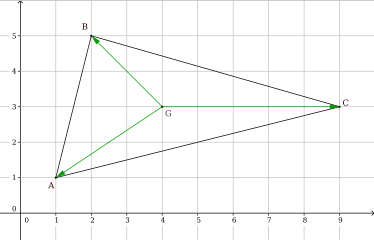
Dans un repère orthonormal du plan on considère les points $ A, B $ et $ C $ de coordonnées $ A(1;1) , B(2;5) $ et $ C(9;3) $.
Soit $ G(x;y) $ un point du plan tel que $ \overrightarrow{GA}+\overrightarrow{GB}+\overrightarrow{GC}=\overrightarrow{0} $.
- Déterminer en fonction de $ x $ et de $ y $ les coordonnées des vecteurs $ \overrightarrow{GA} $, $ \overrightarrow{GB} $ et $ \overrightarrow{GC} $.
- Traduire l'égalité $ \overrightarrow{GA}+\overrightarrow{GB}+\overrightarrow{GC}=\overrightarrow{0} $ par deux équations d'inconnues $ x $ et $ y $. En déduire les coordonnées de $ G $.
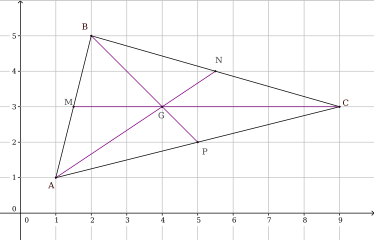
- On note $ M, N, P $ les milieux respectifs des segments $ [AB], [BC] $ et $ [AC] $. Calculer les coordonnées des points $ M, N, P $.
- Montrer que les points $ A, G $ et $ N $ sont alignés ainsi que les points $ B, G, P $ et les points $ C, G, M $.
- Que représente le point $ G $ pour le triangle $ ABC $?
Les coordonnées du vecteur $ \overrightarrow{GA} $ sont $ \begin{pmatrix}x_A - x_G \\ y_A - y_G\end{pmatrix} $ Les coordonnées des vecteurs $ \overrightarrow{GA} $, $ \overrightarrow{GB} $ et $ \overrightarrow{GC} $ sont :
$ \overrightarrow{GA}\begin{pmatrix}1 - x \\ 1 - y\end{pmatrix} $
$ \overrightarrow{GB}\begin{pmatrix}2 - x \\ 5 - y\end{pmatrix} $
$ \overrightarrow{GC}\begin{pmatrix}9 - x \\ 3 - y\end{pmatrix} $
On obtient les coordonnées du vecteur $ \overrightarrow{GA}+\overrightarrow{GB}+\overrightarrow{GC} $ en faisant la somme des coordonnées des vecteurs $ \overrightarrow{GA} $, $ \overrightarrow{GB} $ et $ \overrightarrow{GC} $ :
$ (1 - x)+(2 - x)+(9 - x)=12 - 3x $
$ (1 - y)+(5 - y)+(3 - y)=9 - 3y $
Les coordonnées du vecteur $ \overrightarrow{GA}+\overrightarrow{GB}+\overrightarrow{GC} $ sont donc $ \begin{pmatrix}12 - 3x \\ 9 - 3y\end{pmatrix} $
Le vecteur $ \overrightarrow{GA}+\overrightarrow{GB}+\overrightarrow{GC} $ est égal au vecteur nul si et seulement si ses coordonnées sont nulles donc si et seulement si :
$ \begin{cases} 12 - 3x=0 \\ 9 - 3y=0 \end{cases} $
On obtient donc $ x=\dfrac{12}{3}=4 $ et $ y=\dfrac{9}{3}=3 $.
Les coordonnées du point $ G $ sont donc $ G(4;3) $
Le milieu $ M $ de $ [AB] $ a pour coordonnées :
$ M\left(\dfrac{x_A+x_B}{2}~;~\dfrac{y_A+y_B}{2}\right) $
$ M\left(\dfrac{1+2}{2}~;~\dfrac{1+5}{2}\right) $
$ M\left(\dfrac{3}{2}~;~3\right) $
Un calcul analogue donne :
$ N\left(\dfrac{11}{2}~;~4\right) $
$ P\left(5~;~2\right) $
Pour montrer que les points $ A, G $ et $ N $ sont alignés on va montrer que les vecteurs $ \overrightarrow{AG} $ et $ \overrightarrow{AN} $ sont colinéaires.
Les coordonnées du vecteur $ \overrightarrow{AG} $ sont :
$ \overrightarrow{AG}\begin{pmatrix}4 - 1 \\ 3 - 1\end{pmatrix} $ soit $ \overrightarrow{AG}\begin{pmatrix}3 \\ 2\end{pmatrix} $
Les coordonnées du vecteur $ \overrightarrow{AN} $ sont :
$ \overrightarrow{AN}\begin{pmatrix}\dfrac{11}{2} - 1 \\ \\ 4 - 1\end{pmatrix} $ soit $ \overrightarrow{AN}\begin{pmatrix}\dfrac{9}{2} \\ \\ 3\end{pmatrix} $
On calcule le déterminant de $ \overrightarrow{AG} $ et $ \overrightarrow{AN} $ :
$ \det\left(\overrightarrow{AG},\overrightarrow{AN}\right) = 3 \times 3 - \dfrac{9}{2} \times 2=9 - 9=0 $
Le déterminant est nul donc les vecteurs $ \overrightarrow{AG} $ et $ \overrightarrow{AN} $ sont colinéaires. Les points $ A, G, N $ sont donc alignés.
Les autres alignements se démontrent de manière similaire :
Les coordonnées du vecteur $ \overrightarrow{BG} $ sont :
$ \overrightarrow{BG}\begin{pmatrix}4 - 2 \\ 3 - 5\end{pmatrix} $ soit $ \overrightarrow{BG}\begin{pmatrix}2 \\ - 2\end{pmatrix} $
Les coordonnées du vecteur $ \overrightarrow{BP} $ sont :
$ \overrightarrow{BP}\begin{pmatrix}5 - 2 \\ 2 - 5\end{pmatrix} $ soit $ \overrightarrow{BP}\begin{pmatrix}3 \\ - 3\end{pmatrix} $
On calcule le déterminant de $ \overrightarrow{BG} $ et $ \overrightarrow{BP} $ :
$ \det\left(\overrightarrow{BG},\overrightarrow{BP}\right) = 2 \times ( - 3) - ( - 2) \times 3 = - 6+6=0 $
Le déterminant est nul donc les vecteurs $ \overrightarrow{BG} $ et $ \overrightarrow{BP} $ sont colinéaires et les points $ B, G, P $ sont alignés.
Les coordonnées du vecteur $ \overrightarrow{CG} $ sont :
$ \overrightarrow{CG}\begin{pmatrix}4 - 9 \\ 3 - 3\end{pmatrix} $ soit $ \overrightarrow{CG}\begin{pmatrix} - 5 \\ 0\end{pmatrix} $
Les coordonnées du vecteur $ \overrightarrow{CM} $ sont :
$ \overrightarrow{CM}\begin{pmatrix}\dfrac{3}{2} - 9 \\ \\ 3 - 3\end{pmatrix} $ soit $ \overrightarrow{CM}\begin{pmatrix} - \dfrac{15}{2}\\ \\ 0\end{pmatrix} $
On calcule le déterminant de $ \overrightarrow{CG} $ et $ \overrightarrow{CM} $ :
$ \det\left(\overrightarrow{CG},\overrightarrow{CM}\right) = - 5 \times 0 - \left( - \dfrac{15}{2}\right) \times 0 =0+0=0 $
Le déterminant est nul donc les vecteurs $ \overrightarrow{CG} $ et $ \overrightarrow{CM} $ sont colinéaires et les points $ C, G, M $ sont alignés.
Puisque $ M, N, P $ sont les milieux des segments $ [AB], [BC] $ et $ [AC] $, les droites $ (AN), (BP) $ et $ (CM) $ sont les médianes du triangle $ ABC $.
D'après la question précédente, le point $ G $ appartient à chacune de ces médianes.
Le point $ G $ est donc le point de concours des médianes c'est à dire le centre de gravité du triangle $ ABC $.
→ Pour réviser : Montrer que 3 points sont alignés (vecteurs)
Coordonnées et parallélogramme
Soient $ A\left(1 ; 1\right), B\left(5 ; - 1\right) $ et $ C\left(2 ; 3\right) $.
- Déterminer les coordonnées du point $ D $ tel que $ ABCD $ soit un parallélogramme.
- Déterminer les coordonnées du point $ E $ tel que $ ABEC $ soit un parallélogramme.
- Montrer alors qu'$ ABEC $ est un rectangle.
On sait que $ A(1 ; 1) $, $ B(5 ; -1) $ et $ C(2 ; 3) $.
Soit $ D(x_D ; y_D) $ le point tel que $ ABCD $ soit un parallélogramme.
Si $ ABCD $ est un parallélogramme, alors $ \overrightarrow{AB} = \overrightarrow{DC} $. On a :
$ \overrightarrow{AB} \begin{pmatrix} 5 - 1 \\ -1 - 1 \end{pmatrix} = \overrightarrow{AB} \begin{pmatrix} 4 \\ -2 \end{pmatrix} $
et
$ \overrightarrow{DC} \begin{pmatrix} 2 - x_D \\ 3 - y_D \end{pmatrix} $
L'égalité des vecteurs donne :
$ \begin{cases} 4 = 2 - x_D \\ -2 = 3 - y_D \end{cases} \iff \begin{cases} x_D = 2 - 4 = -2 \\ y_D = 3 + 2 = 5 \end{cases} $
Le point $ D $ a pour coordonnées $ (-2 ; 5) $.
Vérifions avec l'égalité $ \overrightarrow{BC} = \overrightarrow{AD} $ :
$ \overrightarrow{BC} \begin{pmatrix} 2 - 5 \\ 3 - (-1) \end{pmatrix} = \overrightarrow{BC} \begin{pmatrix} -3 \\ 4 \end{pmatrix} $
$ \overrightarrow{AD} \begin{pmatrix} -2 - 1 \\ 5 - 1 \end{pmatrix} = \overrightarrow{AD} \begin{pmatrix} -3 \\ 4 \end{pmatrix} $
L'égalité est bien vérifiée.
Soit $ E(x_E ; y_E) $ le point tel que $ ABEC $ soit un parallélogramme.
Dans ce cas, $ \overrightarrow{AB} = \overrightarrow{CE} $. On a $ \overrightarrow{AB} \begin{pmatrix} 4 \\ -2 \end{pmatrix} $ et :
$ \overrightarrow{CE} \begin{pmatrix} x_E - 2 \\ y_E - 3 \end{pmatrix} $
L'égalité des vecteurs donne :
$ \begin{cases} x_E - 2 = 4 \\ y_E - 3 = -2 \end{cases} \iff \begin{cases} x_E = 6 \\ y_E = 1 \end{cases} $
Le point $ E $ a pour coordonnées $ (6 ; 1) $.
Vérifions avec l'égalité $ \overrightarrow{BE} = \overrightarrow{AC} $ :
$ \overrightarrow{BE} \begin{pmatrix} 6 - 5 \\ 1 - (-1) \end{pmatrix} = \overrightarrow{BE} \begin{pmatrix} 1 \\ 2 \end{pmatrix} $
$ \overrightarrow{AC} \begin{pmatrix} 2 - 1 \\ 3 - 1 \end{pmatrix} = \overrightarrow{AC} \begin{pmatrix} 1 \\ 2 \end{pmatrix} $
L'égalité est bien vérifiée.
Pour prouver que le parallélogramme $ ABEC $ est un rectangle, nous pouvons montrer qu'il possède un angle droit en utilisant la réciproque du théorème de Pythagore dans le triangle $ ABE $.
Calculons les longueurs des côtés :
$ AB = \sqrt{4^2 + (-2)^2} = \sqrt{16 + 4} = \sqrt{20} = 2\sqrt{5} $
$ BE = \sqrt{1^2 + 2^2} = \sqrt{1 + 4} = \sqrt{5} $
Le vecteur $ \overrightarrow{AE} $ a pour coordonnées :
$ \overrightarrow{AE} \begin{pmatrix} x_E - x_A \\ y_E - y_A \end{pmatrix} = \overrightarrow{AE} \begin{pmatrix} 6 - 1 \\ 1 - 1 \end{pmatrix} = \overrightarrow{AE} \begin{pmatrix} 5 \\ 0 \end{pmatrix} $
$ AE = \sqrt{5^2 + 0^2} = 5 $
On compare $ AE^2 $ et $ AB^2 + BE^2 $ :
$ AE^2 = 5^2 = 25 $
$ AB^2 + BE^2 = (\sqrt{20})^2 + (\sqrt{5})^2 = 20 + 5 = 25 $
D'après la réciproque du théorème de Pythagore, le triangle $ ABE $ est rectangle en $ B $.
L'angle $ \widehat{ABE} $ est donc un angle droit.
Un parallélogramme qui possède un angle droit est un rectangle, donc $ ABEC $ est un rectangle.
Pour réviser : Calculer les coordonnées d'un vecteur.