
Produit scalaire et quadrillage. Calcul d’angle.
Créez un compte gratuit pour suivre votre avancement et reprendre où vous avez laissé.
Créer un compteObjectif travaillé
Dans cet exercice, l'unité de longueur correspond au côté d'un carré du quadrillage.
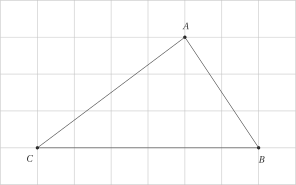
- À l'aide du quadrillage, calculer le produit scalaire $ \overrightarrow{CB}\cdot\overrightarrow{CA} $ puis les normes $ \left\Vert \overrightarrow{CB} \right\Vert $ et $ \left\Vert \overrightarrow{CA} \right\Vert $.
- En déduire la valeur exacte de $ \cos\left( \overrightarrow{CB} ;\overrightarrow{CA} \right) $.
Donner la valeur arrondie au degré de l'angle $ \left( \overrightarrow{CB} ; \overrightarrow{CA} \right) $.
Corrigé
Tout d'abord, traçons le projeté orthogonal $ H $ du point $ A $ sur la droite $ (CB) $ :
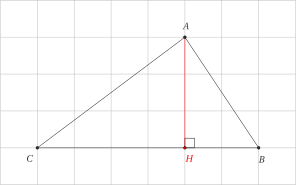
Comme l'angle $ \left( \overrightarrow{CB} ; \overrightarrow{CA} \right) $ est un angle aigu :
$ \overrightarrow{CB} \cdot \overrightarrow{CA} =CB \times CH $
$ \overrightarrow{CB} \cdot \overrightarrow{CA} =6 \times 4=24. $Par ailleurs, on a immédiatement :
$ \left\Vert \overrightarrow{CB} \right\Vert =CB=6. $
Pour calculer la longueur du segment $ [CA] $, on utilise le théorème de Pythagore dans le triangle $ AHC $ rectangle en $ H $ :
$ AC{}^2 =CH{}^2 +HA{}^2 =4{}^2 +3{}^2 $
$ \phantom{AC{}^2 }=16+9=25 $Donc :
$ \left\Vert \overrightarrow{CA} \right\Vert =AC=\sqrt{25} = 5 $- Pour calculer la valeur de $ \cos\left( \overrightarrow{CB} ;\overrightarrow{CA} \right) $, on utilise la formule donnant le produit scalaire à l'aide du cosinus :
$ \overrightarrow{CB} \cdot \overrightarrow{CA} = \left\Vert \overrightarrow{CB} \right\Vert \times \left\Vert \overrightarrow{CA} \right\Vert \times \cos\left( \overrightarrow{CB} ;\overrightarrow{CA} \right) $
On en déduit :
$ \cos\left( \overrightarrow{CB} ;\overrightarrow{CA} \right) = \dfrac{\overrightarrow{CB} \cdot \overrightarrow{CA} }{ \left\Vert \overrightarrow{CB} \right\Vert \times \left\Vert \overrightarrow{CA} \right\Vert } $
$ \cos\left( \overrightarrow{CB} ;\overrightarrow{CA} \right) =\dfrac{24}{6 \times 5} =0{,}8 $.
À la calculatrice (touche « $ \cos{}^{ - 1} $ » ou « Arccos » ), on trouve que l'angle $ \left( \overrightarrow{CB} ;\overrightarrow{CA} \right) $ vaut approximativement $ 37^\circ $ au degré près.
Remarque : il était aussi possible et plus simple, ici, de calculer une valeur approchée de l'angle $ \left( \overrightarrow{CB} ;\overrightarrow{CA} \right) $ à l'aide des formules trigonométriques vues en classe de troisième dans le triangle rectangle $ AHC $.