
[ROC] Théorème de la médiane
Créez un compte gratuit pour suivre votre avancement et reprendre où vous avez laissé.
Créer un compteObjectif travaillé
Exercices
Énoncé
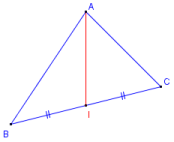
$ ABC $ est un triangle quelconque et $ I $ désigne le milieu de $ \left[BC\right] $.
En utilisant la relation de Chasles en faisant intervenir le point $ I $, montrer que :
$ AB^{2}+AC^{2}=2AI^{2}+\dfrac{BC^{2}}{2} $Montrer de même que :
$ AB^{2} - AC^{2}=2\,\overrightarrow{AI}\cdot\overrightarrow{CB} $Montrer enfin que :
$ \overrightarrow{AB}\cdot\overrightarrow{AC}=AI^{2} - \dfrac{1}{4}BC^{2} $
Corrigé
On développe en utilisant la relation de Chasles $ \overrightarrow{AB}=\overrightarrow{AI}+\overrightarrow{IB} $ et $ \overrightarrow{AC}=\overrightarrow{AI}+\overrightarrow{IC} $ :
$ AB^{2} + AC^{2} = \overrightarrow{AB}^{2} + \overrightarrow{AC}^{2} $
$ \phantom{AB^{2} + AC^{2}} = \left(\overrightarrow{AI} + \overrightarrow{IB}\right)^{2} + \left(\overrightarrow{AI} + \overrightarrow{IC}\right)^{2} $
$ \phantom{AB^{2} + AC^{2}} = 2\,\overrightarrow{AI}^{2} + 2\,\overrightarrow{AI}\cdot\left(\overrightarrow{IB} + \overrightarrow{IC}\right) + \overrightarrow{IB}^{2} + \overrightarrow{IC}^{2} $Or $ I $ est le milieu de $ [BC] $, donc $ \overrightarrow{IB} + \overrightarrow{IC} = \vec{0} $ et $ IB = IC = \dfrac{1}{2}BC $. On en déduit :
$ \overrightarrow{IB}^{2} + \overrightarrow{IC}^{2} = IB^{2} + IC^{2} = \dfrac{1}{4}BC^{2} + \dfrac{1}{4}BC^{2} = \dfrac{1}{2}BC^{2} $
Finalement :
$ AB^{2} + AC^{2} = 2AI^{2} + \dfrac{1}{2}BC^{2} $La démarche est analogue en remplaçant le signe $ + $ par $ - $ :
$ AB^{2} - AC^{2} = \left(\overrightarrow{AI} + \overrightarrow{IB}\right)^{2} - \left(\overrightarrow{AI} + \overrightarrow{IC}\right)^{2} $
$ \phantom{AB^{2} - AC^{2}} = 2\,\overrightarrow{AI}\cdot\overrightarrow{IB} + \overrightarrow{IB}^{2} - 2\,\overrightarrow{AI}\cdot\overrightarrow{IC} - \overrightarrow{IC}^{2} $
$ \phantom{AB^{2} - AC^{2}} = 2\,\overrightarrow{AI}\cdot\left(\overrightarrow{IB} - \overrightarrow{IC}\right) $(car $ IB = IC $, donc $ \overrightarrow{IB}^{2} = \overrightarrow{IC}^{2} $).
Or $ I $ est le milieu de $ [BC] $, donc $ \overrightarrow{IB} - \overrightarrow{IC} = \overrightarrow{IB} + \overrightarrow{CI} = \overrightarrow{CB} $. On conclut :
$ AB^{2} - AC^{2} = 2\,\overrightarrow{AI}\cdot\overrightarrow{CB} $On développe le produit scalaire :
$ \overrightarrow{AB}\cdot\overrightarrow{AC} = \left(\overrightarrow{AI} + \overrightarrow{IB}\right)\cdot\left(\overrightarrow{AI} + \overrightarrow{IC}\right) $
$ \phantom{\overrightarrow{AB}\cdot\overrightarrow{AC}} = AI^{2} + \overrightarrow{AI}\cdot\left(\overrightarrow{IB} + \overrightarrow{IC}\right) + \overrightarrow{IB}\cdot\overrightarrow{IC} $
$ \phantom{\overrightarrow{AB}\cdot\overrightarrow{AC}} = AI^{2} + \overrightarrow{IB}\cdot\overrightarrow{IC} $(car $ \overrightarrow{IB} + \overrightarrow{IC} = \vec{0} $).
Comme $ I $ est le milieu de $ [BC] $, on a $ \overrightarrow{IB} = -\dfrac{1}{2}\overrightarrow{BC} $ et $ \overrightarrow{IC} = \dfrac{1}{2}\overrightarrow{BC} $, donc :
$ \overrightarrow{IB}\cdot\overrightarrow{IC} = -\dfrac{1}{4}\overrightarrow{BC}^{2} = -\dfrac{1}{4}BC^{2} $
Finalement :
$ \overrightarrow{AB}\cdot\overrightarrow{AC} = AI^{2} - \dfrac{1}{4}BC^{2} $